Monday, 1 November 2010

Characters

Sarah Jennings Played by Daisy Holland - Young innocent girl, Protagonist, last girl, wanderer

Darren Jennings Played by Edwin Cookson - Brother, Distant from family and sister, Archetypal stoner, party goer character, little compassion for the sister

Thomas Micheals - Friend of darren, similar in character

Simon Jones - Friend of darren, similar in character

Lilly Anderson - Played by Holly Keller-Cooper Typical Tom Boy Character, slightly more compassionate than the boys.

Bernard Jennings played by David Dalziel- Father of Darren and Sarah, Very nice to daughter, Feels antipathy for son due to his lifestyle.

Mary Jennings Karen Dalziel - Mother of Darren and Sarah, Typical mother, Worried about camping trip, Maternal.

William Fyles Played by Erhan Korkman - Antagonist of the film, wears a mask, Has turbelant past, Mentally Ill, is a killer.

Props

Friday, 22 October 2010

Mise en Scene

Mise én Scene is an expression used to describe the visual style of a film. The Mise én Scene within horror films plays a highly important role in creating the conventional atmosphere in which we are accustomed to. Because these will be an important part of filming I will now research into the Mise én Scene of horror films. I will do this by trying to dissect the aspects which make the mise en scene what it is.

Lighting
The lighting within horror movies is an integral part of creating atmosphere. The lighting is often very dark but has lights shone on the protoganist or antagonist or whoever the shot is focusing on. This is brought about by having a dark, dimly lit setting, accompanied by coloured light, we will use this technique within our trailer.

Colour Scheme
The colour scheme of film is often a dark pallete of deep blues greens and reds, depending on the scene. It is hard to define yet what interesting thing comes up is the fact the a films colour scheme is consistent throughout the film, and often transported into the posters and adverts. This is to keep a consistent definitive mood that makes the film easy to identify. Before doing our filming we will create a colour scheme in which to base each shot on in tyerms of the colour, this will help add a visual consitency to the film making it seem a higher standerd.

Decor
The decor of the film is an important way of creating subtle atmospheric nuance in which the veiwer can become more immersed within the world of the film.

Wednesday, 20 October 2010

British Board of Film Classification 15

’18′

Suitable only for adults

No-one younger than 18 may see an ‘18’ film in a cinema.

No-one younger than 18 may rent or buy an ‘18’ rated video.

In line with the consistent findings of the BBFC’s public consultations and The Human Rights Act 1998, at ‘18’ the BBFC’s guideline concerns will not normally override the principle that adults should be free to choose their own entertainment. Exceptions are most likely in the following areas:

  • where the material is in breach of the criminal law, or has been created through the commission of a criminal offence
  • where material or treatment appears to the BBFC to risk harm to individuals or, through their behaviour, to society – for example, any detailed portrayal of violent or dangerous acts, or of illegal drug use, which may cause harm to public health or morals. This may include portrayals of sexual or sexualised violence which might, for example, eroticise or endorse sexual assault
  • where there are more explicit images of sexual activity which cannot be justified by context. Such images may be appropriate in ‘R18’ works, and in ‘sex works’ (see below) would normally be confined to that category.
ddd

British Board of Film Classification Research

The British Board of Film Classification is an independent, non-governmental body which has classified cinema films since it was set up in 1912 and videos/ DVDs since the Video Recordings Act was passed in 1984. Basically, it gives each film released a rating that defines what age the audience who view the film have to be. Creating a promotional campaign for a slasher horror film i will decide on which classification age limit is appropriate for our trailer.

Universal – Suitable for all

It is impossible to predict what might upset any particular child. But a ‘U’ film should be suitable for audiences aged four years and over. ‘U’ films should be set within a positive moral framework and should offer reassuring counterbalances to any violence, threat or horror.

If a work is particularly suitable for a pre-school child to view alone, this will be indicated in the Consumer Advice.


Parental Guidance

General viewing, but some scenes may be unsuitable for young children

Unaccompanied children of any age may watch. A ‘PG’ film should not disturb a child aged around eight or older. However, parents are advised to consider whether the content may upset younger or more sensitive children.


Suitable for 12 years and over

Exactly the same criteria are used to classify works at ‘12A’ and ‘12’. These categories are awarded where the material is suitable, in general, only for those aged 12 and over. Works classified at these categories may upset children under 12 or contain material which many parents will find unsuitable for them.


Suitable only for 15 years and over

No one younger than 15 may see a ‘15’ film in a cinema. No one younger than 15 may rent or buy a ‘15’ rated video work.

Discrimination

The work as a whole must not endorse discriminatory language or behaviour.

Drugs

Drug taking may be shown but the film as a whole must not promote or encourage drug misuse. The misuse of easily accessible and highly dangerous substances (for example, aerosols or solvents) is unlikely to be acceptable.


Suitable only for adults

No-one younger than 18 may see an ‘18’ film in a cinema.

No-one younger than 18 may rent or buy an ‘18’ rated video.

In line with the consistent findings of the BBFC’s public consultations and The Human Rights Act 1998, at ‘18’ the BBFC’s guideline concerns will not normally override the principle that adults should be free to choose their own entertainment. Exceptions are most likely in the following areas:

  • where the material is in breach of the criminal law, or has been created through the commission of a criminal offence
  • where material or treatment appears to the BBFC to risk harm to individuals or, through their behaviour, to society – for example, any detailed portrayal of violent or dangerous acts, or of illegal drug use, which may cause harm to public health or morals. This may include portrayals of sexual or sexualised violence which might, for example, eroticise or endorse sexual assault
  • where there are more explicit images of sexual activity which cannot be justified by context. Such images may be appropriate in ‘R18’ works, and in ‘sex works’ (see below) would normally be confined to that category.

In the case of video works (including video games), which may be more accessible to younger viewers, intervention may be more frequent than for cinema films.

Monday, 18 October 2010

Stock Characters in Slasher Horror Research

In horror movies there are several recurring archetypal stock characters with definate characteristics that make up the cast, to help with creating characters in our film trailer i will research these characters and their characteristics.

The Wanderer
The wanderer is a character who strays away from the group to investigate something, and at sometime in his or her journey gets murdered by the antagonist or kidnapped, but mostly killed. A good example of this is Andy (Mike Vogel) in the Texas Chainsaw Massacre 2003 dir. Marcus Nispel. He goes off to look for his friend and gets taken by leatherface.


The Popular Girl
The Popular Girl is often an arrogant, pretty, popular girl that is die within the the logic of the film, she often thinks herself before others and is paid back with some negative consequences, she is often romantically linked with one of the jocks. An example of this character are the cheerleaders in jeepers creepers 2.


The Jock
The Jock is large sporty male, who is probably not very intelligent but does have power within the group, he often tries to do something heroic but endings up being killed. An example of this is the male in the picture above from jeepers creepers.

the final girl
The final girl is a horror film (particularly slasher film) trope that specifically refers to the last woman or girl alive to confront the killer, ostensibly the one left to tell the story. The final girl has been observed in dozens of films, including Halloween, Friday the 13th, A Nightmare on Elm Street, The Texas Chain Saw Massacre, Alien and Scream.


The Pervert
The Pervert is a character that peeps at a girl while she isn't looking and often gets killed eventually or as a result of this, and example of this is


Friday, 15 October 2010

Stars of Horror Movies Research

To gauge the traits of an archetypal horror star i will analyze some of the biggest horror stars of hollywood. I will analyzing things such as: Movies they have starred in, age, how they look and the characters they play

William Defoe
William Defoe has starred in a selection of horror movies for example: Anamorph and Antichrist I will now list some of reasons why he has been chosen to be a horror protagonist or antagonist. He often plays very serious, bordering on scary characters, so he has built up a repuatation of being like this, this make the audience associate with this type of role instantly and there isn't as much need to set up the type of character. He also has quite a scary looking face. He is in his mid 50s, this is ideal due the fact that the very intense scary archetypal characters in lots of horror movies are about this age. When we film we will try to find a actor with a similar sense of intensity for the role of the pedophile, if we do eventually follow through with this idea.

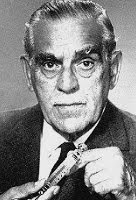
Boris Karloff
Boris Karloff (23 November 1887 – 2 February 1969), whose real name was William Henry Pratt, was an English-born actor who emigrated to Canada in the 1910s. Karloff performed in a variety of contexts throughout his career, but is best remembered for his roles in horror films and his portrayal of Frankenstein's monster in the 1931 film Frankenstein, 1935 film Bride of Frankenstein, and 1939 film Son of Frankenstein. His popularity following Frankenstein in the early 1930s was such that for a brief time he was billed simply as "Karloff" or, on some movie posters, "Karloff the Uncanny".

Brainstorm of Horror Genre Prezi

Wednesday, 13 October 2010

Horror Magazines Research

Selected Horror Magazines


Analysis
To gain a better understanding of how horror is promoted in magazines i have compiled these generic horror magazines in an attempt to analyze the key aspects, this will eventually help my a lot as research due to the fact the we will be making a horror magazine promoting our film. I have some experience in this due to the fact that last year I created a magazine front cover to promote a musician. I will present my findings in bullet point form.


  • They all have a dark color scheme that is contrasted by a bright lurid title.
  • The typography used is related to some sort of horror genre, for example fangoria uses vampiric font colored in red to semiotically represent blood.
  • The named fangoria has the word fang in it relating to vampires or animals.
  • They all have a antagonist from a horror movie on the front, this makes the audience instantly associate this with horror.
  • They follow much of the conventions we learnt about last year, for example they have the title the side stories, the price and the tag-line in roughly the same place.

Horror Iconography and Ideology

Movie Posters


Questions
1.What visual and written codes are being used?
In the posters above the visual code patterns that emerge are that of darkness and colours associated with horror, and the text corresponds with the specific sub genre for example hatchet II is a slasher horror that has large dominant lettering, semiotically representing the antagonist.


2.What information do they provide about the films?
They give the title, the actors, the director, the opening dates and the credits.


3.What other information might you have expected but is missing?
some do not have taglines and some do not show the stars


4.In what ways do these posters create a sense of enigma?.
They are very vague when it comes to the protagonist and antagonist as well as mode of killing yet they do give a few reference to it, and also they show a bit of the setting in some of them.


5.How are the film producers trying to create a sense of danger and equilibrium?
By using dark oppressive colours and frightening imagery like weapons or gore, also they usually show the antagonist in a scary position.


6.What genre do these films belong to?
The horror genre, though there are sub genres like supernatural and slasher horror in there.


7.What are the generic conventions that are at work in these posters?
blood, gore, weapons, death, youth and fear. these all culminate to create an atmosphere of fear that we have come accustomed to.


8.What differing representations of 'the other' or the 'monster' do they present?
The often shroud it in mystery by only vaguely showing the antagonist but still they show enough to make one fearful due to the atmosphere created by all the other aspects of the poster

Key Elements of the Horror Genre Analysis

After analyzing both Friday the 13th and the Texas Chainsaw Massacre I have started to recognise patterns emerging. These being mainly of Antagonist vs. Protagonist. In both of the films there is an almost constant formulaic chase of the protagonist by the main antagonist, this journey is littered with death of the protagonist friends and stock characters, Capturing and escaping. In both films the antagonist had a lair, the decor in these were scary and semiotically frightening. There were also several similar stock situations that occurred for example the antagonist ariving out of nowhere. The difference were minor and only due to the fact that there quite disperate films, i could have found much more similar plot-lines. The overall point that I have gained from this exercise is the fact that there is a formula used by production companies and writers to create a horror film, this makes the audience more accustomed to the horror genre

Thursday, 7 October 2010

Key Elements of the Horror Genre


To further my understanding of the key elements of the horror genre i will find a synopsis of an arbitrary horror film and highlight the key elements, I will use a key to show which colour corresponds with each key element. I will then do this a second time with a different horror film and compare and contrast my findings to test how many similarities and dissimilarities there are.


Key

Protagonists

Stock Characters

Plots and Stock Situations

Backgrounds and Decor

Themes

Icons


The Texas Chain Saw Massacre

Sally Hardesty (Marilyn Burns) and her brother, Franklin (Paul A. Partain), travel with three friends, Jerry (Allen Danziger), Kirk (William Vail) and Pam (Teri McMinn), to a cemetery containing the grave of the Hardesty's grandfather. They aim to investigate reports of vandalism and corpse-defilement. Afterward, they decide to visit an old Hardesty family homestead, and on the way, the group picks up a hitchhiker (Edwin Neal). The man speaks and acts bizarrely, and then slashes himself and Franklin with a straight razor before the group forces him out of the van. They later stop at a gas station to refuel, but the proprietor (Jim Siedow) tells them that the

pumps are empty, and they continue to the homestead, intending to return to the gas station later after a fuel truck makes its delivery. Franklin tells Kirk and Pam about a local swimming hole, and the couple head off to find it. Instead, they stumble upon a nearby house; Kirk calls out asking for gas, while Pam waits on the front steps.

Receiving no answer but finding the door unlocked, Kirk enters the house, where Leatherface (Gunnar Hansen) suddenly appears and kills him. Pam enters soon after, finding the house filled with furniture made from human bones. She attempts to flee, but Leatherface catches her before she can escape, impaling her on a meathook. At sunset, Sally's boyfriend Jerry heads out from the old Hardesty house to look for the others. Finding the couple's blanket outside the house, he investigates and finds Pam still alive inside a freezer. Before he can react, Leatherface appears and murders him, stuffing Pam back inside the freezer afterward.

With darkness falling, Sally and Franklin set out to find their friends. As they near the killer's house, calling for the others, Leatherface lunges out of the darkness and murders Franklin with a chainsaw. Sally escapes to the house, finding the desiccated remains of an elderly couple in an upstairs room. She escapes from Leatherface by jumping through a second floor window and continues to flee, eventually arriving at the gas station. As she reaches it, Leatherface disappears into the night. The proprietor at first calms her with offers of help, then binds her with rope and forces her into his truck. He drives to the house, arriving at the same time as the hitchhiker, who turns out to be Leatherface's younger brother. When the pair bring Sally inside, the hitchhiker recognizes and taunts her.

The men torment the bound and gagged Sally, while Leatherface, now dressed as a woman, serves dinner. Leatherface and the hitchhiker bring an old man from upstairs to the table to join the meal. During the night, they decide Sally should be killed by "Grandpa" (John Dugan), out of respect for his work at the slaughter house when he was younger. "Grandpa" is too weak to hit Sally with a hammer, repeatedly dropping it. In the confusion, Sally breaks free, leaps through a window and escapes from the house, running out onto the road. Leatherface and the hitchhiker give chase, but the hitchhiker is run down and killed by a passing semi-trailer truck. Armed with his chainsaw, Leatherface attacks the truck when the driver stops to help, and is hit in the face with a large wrench wielded by the driver. Sally escapes in the bed of a passing pickup truck as Leatherface waves the chainsaw above his head in frustration.


Friday the 13th

On June 13, 1980, a young Jason Voorhees (Caleb Guss) witnesses his mother (Nana Visitor) beheaded by a camp counselor (Stephanie Rhodes) who was trying to escape Mrs. Voorhees's murderous rampage around Camp Crystal Lake. Approximately 30 years later, a group of vacationing friends—Wade (Jonathan Sadowski), Richie (Ben Feldman), Mike (Nick Mennell), Whitney (Amanda Righetti) and Amanda (America Olivo)—arrive at Crystal Lake on a camping trip to find some marijuana that was planted in the woods. As Mike and Whitney explore the abandoned Crystal Lake camp, an adult Jason (Derek Mears) begins to kill the rest of the group one-by-one. Jason also kills Mike, but he spares Whitney and decides to kidnap her because she resembles his mother at a young age.

Six weeks later, Trent (Travis Van Winkle), along with his girlfriend Jenna (Danielle Panabaker), and their friends Bree (Julianna Guill), Chewie (Aaron Yoo), Chelsea (Willa Ford), Nolan (Ryan Hansen) and Lawrence (Arlen Escarpeta) arrive at Trent's summer cabin, which sits on Crystal Lake. The group is unaware of the events that occurred a few weeks prior. Additionally, Clay Miller (Jared Padalecki) arrives in town to search Crystal Lake for his sister Whitney, whom he believes to be alive. Clay eventually makes his way to Trent's cabin, where Jenna agrees to help him look for his sister on the other side of the lake. As Clay and Jenna search for clues to Whitney's disappearance, Jason kills Nolan and Chelsea, who are wakeboarding on the lake. Clay and Jenna reach the old Crystal Lake campgrounds, where they witness Jason hauling a dead body into one of the abandoned camp houses.

The pair run back to warn the others about Jason, who arrives shortly after them and cuts the power to the cabin. After killing Chewie and Lawrence, who ventured outside the house, Jason sneaks inside the cabin and kills Bree. Trent, Clay and Jenna escape the house, but Trent is killed when he reaches the main road. Jason then chases Clay and Jenna back to the campgrounds, where Clay discovers Jason's lair and finds his sister chained to the wall. Clay frees Whitney, and all three attempt to escape as Jason arrives. The trio find an exit, but Jenna is killed before she can get out. Jason comes after Clay and Whitney, but Whitney uses Jason's love and memory of his mother—by pretending to be Mrs. Voorhees—to distract him long enough to stab him in the chest with his own machete. Afterward, Clay dumps Jason's lifeless body into the lake. Before he and Whitney can leave, Jason bursts through the wooden dock and grabs Whitney.